
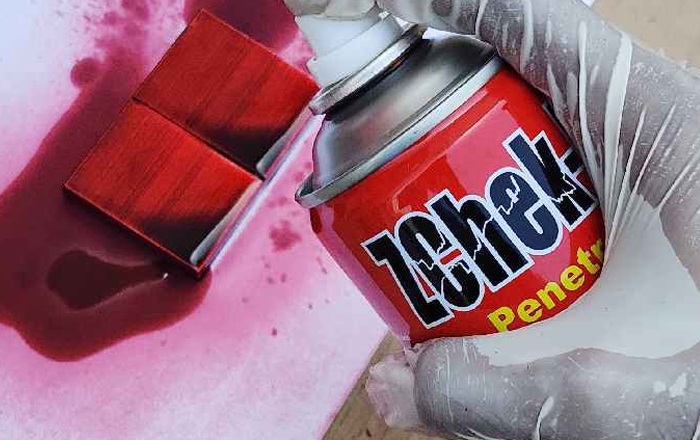
Type 1 vs. Type 2 Penetrant Testing: What Is the Difference?
Liquid Penetrant Inspection (LPI), also known as Penetrant Testing (PT), is one of the most widely used non-destructive testing methods for detecting surface-breaking discontinuities in non-porous materials.
One of the fundamental choices when establishing a penetrant inspection process is whether to use a Type 1 fluorescent penetrant or a Type 2 visible penetrant.
Although both work on the same basic principle, their inspection conditions and typical applications can differ considerably.
What Is Type 1 Penetrant?
Type 1 penetrants are fluorescent penetrants.
After processing, the component is examined under specified UV-A illumination and controlled ambient-light conditions. Penetrant retained within a surface-breaking discontinuity fluoresces, producing a bright indication against the inspection background.
Type 1 penetrants are commonly used where higher inspection sensitivity and controlled inspection conditions are required.
Typical applications can include:
- Aerospace components
- Turbine components
- Critical castings and forgings
- Automotive components
- Precision-engineered parts
- Power-generation components
- Other critical industrial components
What Is Type 2 Penetrant?
Type 2 penetrants are visible penetrants.
They normally produce a strongly contrasting visible indication against the developer background and are examined under suitable visible-light conditions.
Visible dye penetrant inspection is widely used for general industrial inspection, fabrication, welding, maintenance, field inspection, and applications where fluorescent inspection facilities may not be available or required.
Typical applications can include:
- Weld inspection
- Pressure vessels
- Storage tanks
- Pipelines and piping
- Valves
- General fabrication
- Maintenance inspection
- Field NDT
Type 1 vs. Type 2: Key Differences
| Characteristic | Type 1 | Type 2 |
|---|---|---|
| Penetrant | Fluorescent | Visible |
| Examination | UV-A illumination under specified conditions | Visible-light examination |
| Typical sensitivity | Multiple sensitivity classifications available | Application/specification dependent |
| Inspection environment | Usually controlled | Often suitable for shop and field applications |
| Common applications | Aerospace and critical component inspection | Welding, fabrication, maintenance and general industry |
| Primary indication | Fluorescent indication | High-contrast visible indication |
Which Penetrant Should You Choose?
The decision should not simply be based on whether fluorescent or visible inspection is more convenient.
Consider the following factors:
- Applicable inspection specification
- Required sensitivity
- Component material
- Surface condition
- Type and size of expected discontinuity
- Customer requirements
- Inspection environment
- Production volume
- Available equipment
- Required process controls
Where the governing specification requires a particular penetrant type, method, or sensitivity, those requirements take precedence.
What About Penetrant Removal Methods?
Penetrant type and penetrant removal method are separate classifications.
Depending on the applicable system and specification, penetrant processes may include water-washable, post-emulsifiable lipophilic, solvent-removable, or post-emulsifiable hydrophilic methods.
This distinction is important because selecting “Type 1” alone does not completely define the penetrant inspection process.
A complete process specification may need to identify the penetrant type, removal method, sensitivity level, developer, processing parameters, and examination conditions.
Why Consumable Quality Matters
Penetrant testing depends on the performance of the complete inspection system.
Consistent penetrant characteristics, proper removal, appropriate developer application, controlled inspection conditions, correct processing parameters, trained personnel, and adequate process monitoring all contribute to reliable inspection.
For critical applications, penetrant materials should also meet the relevant specifications and customer approval requirements.
ZChem USA: Penetrant Inspection Solutions
ZChem Specialities USA LLC offers NDT solutions for Liquid Penetrant Inspection and Magnetic Particle Inspection applications.
Our portfolio includes penetrants, developers, removers and related NDT materials, together with MPI and LPI equipment and accessories.
With chemical research capabilities, equipment-design expertise, and experience serving customers internationally, ZChem focuses on providing practical NDT solutions for demanding industrial applications.
Need Help Selecting Type 1 or Type 2?
Tell the ZChem USA team about your:
Component → Material → Applicable specification → Required sensitivity → Inspection process → Application
Our team can help identify a suitable penetrant inspection solution for your requirements.
Visit www.zchemusa.com to Talk to Our Expert, Request a Sample, or Request Pricing.
ZChem USA
MPI & LPI Consumables and Equipment
Excellence Delivered.